
Unlike in many other situation where you may suffer an injury on someone else's property, such as slip-and-fall, trip-and-fall or being electrocuted by an exposed wire, as a plaintiff who suffers an injury while staying at a hotel, you might have legal advantage when making and proving your case. To make as strong of a case as possible against a hotel for the suffered injury you / your attorney should keep in mind the "special relationship" doctrine that comes into play in these types of cases. Establishing a special relationship can make a difference between winning and losing a case and it will certainly affect your ability to settle your claim fairly before trial.
Indeed, guests and hotel have special relationship. Guests have no time or expertise to identify dangers while hotel owners have the time and resources to do so. Generally, hotels have a continuous duty to inspect their premises for anticipated dangers, just like landlords of apartment buildings. With respect to common areas and hotel rooms in particular, innkeepers and premises owners are required to perform “reasonably careful” inspections at “reasonable intervals” to learn of dangers not apparent to the eye. Rodenberger v Frederickson (1952) 111 Cal.App.2d 139. In some ways this duty is similar to the obligation that grocery stores have in conducting regular inspections of aisles, maintaining sweeping logs and taking reasonable steps to insure there are no conditions on the floor that would make their customers slip or trip. However, in a typical hotel injury case involving a non apparent defect (such as broken shower door, slippery floor, etc...), an argument should be made to distinguish this situation from a grocery slip and fall. A guest of a hotel is particularly vulnerable because he/she doesn't have either time or expertise to detect those types of dangers. A guest obviously cannot be expected to inspect a hotel room before checking in. At the same time, hotel owners and staff are in the best position to ensure safety of their premises, due to continuously maintaining premises and having the resources to protect guests from known and possible dangers. This heightened duty to inspect should be emphasize at every stage of the case, including trial, in order to maximize the chances of winning. 
Any monetary recovery of damages in a slip-and-fall injury claim usually turns on whether the owner or the operator of the premises had a notice of the defect/condition that gave rise the injury and a reasonable opportunity to fix the problem, but failed to do so. Thus, if you are a tenant at a certain property that you are renting, and you noticed a certain, potentially dangerous condition, such as defective deck, or unstable porch/stairs, you should notify your landlord of that condition in writing as soon as possible and request on prompt and thorough inspection and repairs. If the landlord doesn’t respond to the letter promptly, you should call the owner and follow up with another letter.
The above strategy is useful for two reasons. First, any prudent and responsible landlord will appreciate this type of concern and will act promptly to remedy the dangerous condition. Secondly, having copies of the letters that you sent that notifying your landlord of the dangerous condition will be a very important evidence in proving any potential injury resulting from failure to repair the condition such as faulty floor, leaking roof, bad plumbing, etc... that lead to an injury of a tenant or a guest at the subject property. If you don't have any evidence of the owner having a notice of the dangerous condition in question, then it will be very difficult or even nearly impossible to win the underlying injury case. 
The owner of any dog is liable for the injuries and damages suffered by any person who is bitten by the dog while in a public place or lawfully in a private place, including the property of the owner of the dog, regardless of the former viciousness of the dog or the owner's knowledge of such viciousness. A person is lawfully on the private property of the dog's owner when he or she is performing any duty imposed by law or postal regulations, or when he or she is on the property by the express or implied invitation of the owner. Thus, pretty much anyone who comes over to someone's home as a (social) guest or to perform any services is covered by this law.
This liability does not preclude all common law defenses. Thus dog owner may raise the defense of assumption of risk or willfully invited injury. This type of defense is typically available is where the alleged victim was attacked after trying to hurt or taunt the dog. Also, if a person knows and and appreciates the danger involved in encountering an animal such as a hostile and barking dog, and voluntarily accepts the risk by exposing himself to the hazard, the injured person may had difficulty winning his case. The defense of assumption of the risk extends only to the danger that the injured person has knowingly assumed. The dog owner would generally not be relieved of liability of the victim's injuries, if he purposefully or negligently concealed a particular hazard, since this would expose the injured person to an unknown risk. Thus, a dog's prior history of vicious behavior and the dog's owners of that behavior is highly relevant and often critical in winning a dog bit injury case. 
Here are three of the most common mistakes that injured persons make after the accident that can substantially reduce or even jeopardize the value of their personal injury case: 1. Waiting for too long to treat after your injury incident. Few things cast more doubt on the severity of your injuries in the eyes of the insurance companies / opposing counsel than large gaps in treatment. This makes sense. After all, the other side is only entitled to doubt how much pain you are suffering from if you were not eager to get help soon after sustaining the injury or if you didn’t treat consistently. Thus, it’s not a good idea to be “tough” after serious accident and decline ambulance services and emergency room treatment if you experience pain. 2. Telling the insurance company adjuster that you weren’t seriously injured. It is almost always the case that the person who is injured in an accident does not experience pain immediately after the impact due to adrenaline rush and other factors. Much of the pain and discomfort in neck, back and other parts of the body appears 24 hour after the accident or even later. Some of the serious symptoms are not noticed until several days after the incident or even longer. Thus, you should not rush to inform your insurance company about what your exact injuries were shortly after the accident because you might just not know it. You are much better of generally describing the pain that you are experiencing and reminding the adjuster that you are not sure what your injuries are as you didn’t undergo a full medical evaluation yet. The claim adjuster might be pressuring you into describing your injuries and pinning you down to your words, so that later it will be harder for you to add new facts or new symptoms. However, you should not give in to that often unethical pressure. There is nothing wrong with answering the “what hurts?” questions with “I don’t know yet” or “I am not sure.” 3. Exaggerating or lying to your attorney. I met clients who would hide the fact that they had prior injuries and accidents until the other side found out about their medical past and used it to weaken our case in a way that they wouldn't be able to otherwise. I have been sent video tapes that captured my client working at a physically demanding job while claiming that he was severally injured, unable to perform any work and was unemployed. You can be sure that it will be an uncomfortable situation for a lawyer to find out a certain fact about his client from the opposing counsel, and in most cases it’s actually an embarrassing discovery that can significantly reduce the values of the injury case, casting serious doubt on the injured person’s credibility, honesty and ability to make the right impression on the judge / jury at trial. This is why one of the golden deposition and trial testimony rules is this: if you don’t remember something you are asked about, simply say so: “I don’t remember.” This type of answer is much better than providing incorrect information, whether you do it innocently or on purpose. 
Insurance companies are some of the largest corporate institutions with large budgets and compelling reasons to invest in prevention of fraud of all kinds - from insurance coverage to recovery of damages. This clearly applies to how a larger number of insurance companies handle injury claims today. The insurers invest resources into studying injury claims (especially the ones that are alleged to be serious) and among other things, determining with the help of highly qualified nurses and doctors whether the medical treatment an injured person received was "reasonable and necessary." These are magic words when it comes to proving damages in court or determining the settlement value of an injury case.
An insurer who discovers that the claimant treated far longer and far more frequently than he likely should have, considering the injuries sustained, will look closely at the nature and the cost of treatment received. If the treatment is clearly excessive and more expensive than it should be, the insurance company will use that information to cast strong doubt on the claimant's credibility, making him/her look like someone who is trying to treat more than needed and inflate claims for the sheer purpose of increasing recovery. This argument works quite often to reduce a claimant's recovery or event lose the case in court where they otherwise could have won. This is because few factors hurt a party in trial in front of a jury than credibility issues. Once the jury determines or event suspects that the claimant treated more than he needed for improper reason, they likely will doubt the entire claim and won't believe much else of what the claimant has to say on the stand. This is exactly the reason why it's a good idea to avoid getting more medical care than you need for your injuries, especially if your case is likely to go to trial. You should especially make sure you don't get too much of the treatment that doesn't help you. Therefore, if for instance you treat for a chiropractor for 1-2 months and you feel no improvement in your pain symptoms, you should at least consider switching to physical therapy, acupuncture, etc. This is because it's usually quite hard to explain why a person went to see a particular doctor for 6 months or more several times a week if it didn't help at all.  Any monetary recovery of damages in a slip-and-fall injury claim usually turns on whether the owner or the operator of the premises had a notice of the defect/condition that gave rise the injury and failed to take reasonable steps to fix the issue. Thus, if you are a tenant at a certain property that you are renting, and you noticed a certain, potentially dangerous condition, such as defective deck, or unstable porch/stairs, you must notify your landlord of that condition in writing as soon as possible and insist on prompt and thorough inspection and repairs. If the landlord doesn’t respond to the letter promptly, you should call the owner and follow up with another letter.
The above strategy is useful for two reasons. First, any prudent and responsible landlord will appreciate that concern and will act promptly to remedy the dangerous condition. Secondly, having copies of the letters that you sent, notifying your landlord of the dangerous condition, will be crucial evidence of proving notice to the landlord and the landlord’s negligence to repair the condition, triggering the coverage of the homeowners insurance policy for the tenant’s injuries. 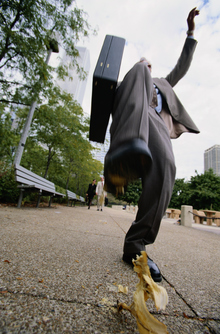
Under California law any business who has an opening in the floor (like a whole) must cover it or provide a guardrail on all open sides. Toeboards shall be installed around the edges at openings where persons may pass below the opening. While the cover is not in place, the openings shall be constantly attended by someone or shall be protected by guardrails. Title 8, Code of California Regulations section 3212(a)(1).
The above law was successfully applied in one recent case in San Joaquin County, where the Plaintiff was awarded $867,000 for injuries and damages as a result of falling into a hole in the floor. (Payton v Installation Services Technologies, Inc.) In that case, the victim was a bread delivery vendor of a restaurant who came for regular delivery and fell into a hole in the floor, created by an wiring installer previously. The hole was unmarked and unguarded in violation of the above law. The power of the above section is the fact that violating it makes the Defendant automatically at fault and liable. This makes proving this type of slip-and-fall or trip-and-fall case easier than a typical slip and fall case, where the Plaintiff faces the common challenge of proving notice of the condition (i.e. that the condition that caused the fall was created by the Defendant or that they were aware of it long enough and failed to take reasonable steps to remedy it). A typical example of this more difficult slip and fall case would be falling on a wet floor or a banana peel at a grocery store. For more useful information on this please visit our page on how to prove a slip-and-fall injury case. |

Contact us
Contact us for a free, no-obligation consultation to discuss your injury claim at (415) 295-4730 Categories
All
|
 RSS Feed