A compression fracture is a fracture of the spine or a vertebrae, and it occurs when a number of vertebrae in the spine are broken. A compression fracture can occur throughout the spine, but most commonly affects two or more vertebrae within the lower thoraci and upper lumbar region, sometimes referred to as the thoacolumbar section of the back.
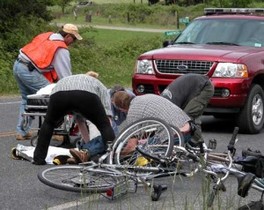
A compression fracture is nearly always a serious injury, bacause the spinal cord is near each of the vertebrae and is at risk whenver they shift. A compression fracture is most likely to be caused by a serious trauma to the back and sine, particularly in a case of falling from a height. Because of the force necessary to cause compression fractures, they often occur with other injureis, including damage to the spinal cord and severe ligament damage. One of my clients recently sustained a compression fracture while riding a bicycle in the mission district in San Francisco. He was broadsided by a car and thrown off his bicylce onto the ground. Considering the circumstances, he was lucky to have survived and not being run over by the oncoming traffic (as it was late at night and the traffic was very light). The injured bicylcist was place on temporarily disability almost immediately and was taken off work for two months.
The symptoms of a compression fracture may include severe limitation of range of motion where a person is unable to turn or bend forward/backwards as freely as he/she would otherwise be able to. In addition, pinching of the spinal cord itself may cause odd tingling or numbness througout the body.
If you have been diagnosed with compression fracture, you should be immobilized to prevent damage to the spinal cord. A rigid, padded surface to support your spine and back is ideal, and of course emergency care might very likely be necessary. In most cases, a surgery is unnecessary to heal a compression fracutre. Wearing a brace or case and allowing the impact part of your body to rest and heal in addition to taking anti-inflammatory medication will allow the body to repair damage within 6 to 10 weeks in many cases of stable fractures.
It is important to note that that pateints who have one compression fracture are more likely to have more such injuries in the future, and therefore prevention of future compression fractures must be address. A doctor should advise patients what activities he/she should avoid to minimize the risk of recurring injury.
Generally, under California law, punitive damages are only available if there is an evidence that the conduct of the party at fault was either intentional and malicious or in conscious disregard for the consequences. As such, punitive damages are not available in the vast majority of injury accidents which are caused by ordinary negligence of a driver or another party that should have exercised greater care in acting in a safe manner.
This means that punitive damages may be available against a driver who causes an accident intentionally or is motivated by some kind of ill will when acting carelessly on the road. Recently, I represented a person who was injured by another driver who was deliberately chasing him after being "cut" on the road by my client, caught up with him and broadsided my client, causing him severe injuries and mild brain trauma.
The opposing counsel, defending the insurance company of the driver at fault, didn't seriously contest my argument that the defendant, in addition to paying for the typical accident damages (medical expenses, wage loss, pain and suffering, emotional distress, etc.) should be liable for punitive damages.
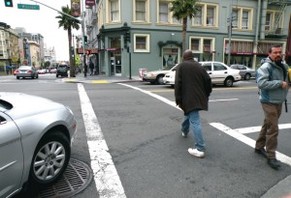
Having studied the more and the less serious injury accidents in San Francisco that involve pedestrians, I noticed that there are two common (but not often discussed) situations in which a driver is more likely to hit a pedestrian when making a right turn:
1. Turning right while making sure that the road is clear for upcoming traffic. Have you ever caught yourself turning rolling forward and right at an intersection while looking to your left to make sure that the road is clear for upcoming traffic? This is a very dangerous move, as the pedestrian who might have started crossing the street just assumes that you will stop without even making sure that you see him. This might end up in a low-speed but nevertheless a serious injury accident.
2. Not looking far enough to your right when making a right turn. It is especially important to look all the way to the right to make sure that you see all the pedestrian who are crossing the street and who are just about to cross the street on the the more crowded streets of downtown San Francisco. No looking all the way to your right, where the pedestrians actually begin crossing the street, increases the risk of hitting a pedestrian at a point where the vehicle almost completed the right turn, impacting the pedestrian with its side.
Keep the above two warnings in mind when you turn right on a red light, and these turns will be much safer - for pedestrians and for you.
A typical scenario: a person sustained an injury in an auto-accident. At first, that injury might not seem or feel to be very serious, but the injured still wishes to get medical care. He gets one of his friends to refer him to a local Chiropractor who treats him for a 3-5 months without referring the patient to other specialists.
This kind of treatment history will necessarily reduce the recovery. I work with some great Chiropractors in San Francisco and Sacramento areas who do a great job for a very reasonable rates for their patients, many of whom are recovering from serious injury accidents. However, I am also aware of the general perception of Chiropractic professional in the community. And the insurance companies are aware of this skeptical perception as well. They know, that the opinion of a Chiropractor is not nearly as credible as that of an a medical doctor. Further, a successful argument can be made by the defense that if an injured person only sought treatment from a chiropractor, this means that he/she wasn't injured seriously; otherwise he would further treatment elsewhere.
Even more importantly, not having a thorough medical examination with an M.D. or an orthopedic surgeon may aggravate a very serious injury (injury to discus, vertebrae, etc...) and make the recovery much slower and painful if not diagnosed and addressed properly.
Thus, it is very important that you see your primary physician at least once and discuss referral to an orthopedic specialist or another doctor who can take your x-rays and examine your injuries more thoroughly for possible disc protrusions/bulges, lacerations, fractures, and other injuries that might not cause as much pain at first, but the ones that tend to also exacerbate with time, if not treated promptly.
One of the most important elements of proving a slip-and-fall claim is demonstrating the the owner of the premises knew or was on notice of dangerous condition, some time before the slip-and-call injury. After all, the owner or the operator of the property is generally held liable only if he/she knew or had a reason to know of the dangerous condition, and failed to take action to remedy it.
Thus, if you notice a condition on the property that you might be using or renting, it's in your best interest to notify the owner of that condition in writing. If there is no response to your letter/fax/e-mail and the property owner doesn't fix the condition within a month or so, continue follow up in writing. Make sure that you have a proof that your letters were received. If you send a letter by mail, make sure that you receive confirmation of delivery. If you fax your letters, keep the facsimile transmission confirmation sheets, and if you e-mail, request read-receipt (although usually it is presumed that an e-mail was received).
Later, if you have the bad luck of being injured because of the dangerous condition that wasn't repaired as requested, those letters will be critical evidence in proving negligence and your ability to recover for your injuries and damages.
Your inability to pay medical bills to get that treatment you need and deserve should never be the reason to actually not be treated after being involved in a car accident or any other injury incident - especially if you know that there is likely to be an insurance coverage by the party at fault. Hundreds of persons injured in the car, motorcycle and other accidents in San Francisco decide not to seek medical treatment because they don't have health insurance and their inability to pay for medical treatment out of pocket.
Many San Francisco injury lawyers, however, have established relationship with doctors who treat injured persons on a lien basis - that is, the doctor accept the risk of paying paid only if and when their patient's injury claim is settled. This means that you are likely to not be required to pay any out-of-pocket expenses until your injury case settles.
If you are unable to pay medical bills and get the treatment for your injuries, this is exactly the time when you should consider hiring a an experienced San Francisco injury lawyer. An attorney will likely refer you to the doctor or several physicians who will be willing to treat you on a lien basis (that is, they agree to be paid only if and when your injury claim settles). Later, when your claim settles, your attorney will be able to negotiate your medical charges with the providers and substantially reduce them, to make sure that you receive greater recovery in your claim.
Some of the most serious injuries are caused by negligent entrustment of dangerous devices or vehicles. Consider the following situation which is very similar to the case a recently handled: A, B, and C are sitting at A's home and having drinks. After a few drinks, A gives B keys to his A's ATV, and B decides to take a ride. B runs the vehicle into the tree. B's body is thrown of the vehicle and against the tree. B suffers debilitating injury and ends up being partially paralyzed.
Although one could argue that ethically B is just as at fault of riding ATV drunk as A for letting him borrow the vehicle, A will likely be liable for B's injuries and damages under the negligent entrustment negligence theory, because A knew or should have known that B was under the influence and was unable to safely operate the vehicle.
In that case, the ATV was not insured (as off-road vehicles do not have to be insured in California). If A is a homeowner, his homeowner's insurance policy will likely cover the injuries caused through the use of vehicle kept on the insured property.
No two injury claims are alike - every injury in every accident is unique as our bodies are so different and respond to injuries and strong mechanical impacts in very different ways. In all cases, however, various factors should be considered as you or your injury lawyer approaches a settlement evaluation. Here are some of the factors that you or an experienced injury lawyer who is handling your case should consider when determining what is the fair value of settlement for your injury case:
(1) How traumatic and "scary" was the incident in which you were involved. Did your airbag deploy? Were you riding a motorcycle and were broadsided on a freeway, being lucky to survive? Did you vehicle catch fire? Was it a roll over incident? A head-on collision, or any other event that make you and would make any reasonable person scared to drive, anxious and unable to focus and sleep for weeks or even months post incident.
(2) How soon did you seek medical treatment - ambulance, emergency room and consistent, continues treatment shortly thereafter indicate serious injury that the victim of the accident had to treat in order to alleviate the pain. On the other hand, if you wait for months to see a doctor, it would be hard to convince the insurance company (or the jury) that you were seriously hurt in an accident. Although some symptoms take time to develop, it would be hardly believable that you didn't experience any pain for months and then, all of a sudden, you started suffering from pain that was caused by an event many months ago.
(3) Prior injuries - were you injured in the past 10 years or so. Was the injury to the same part/parts of your body as the subsequent accident giving rise to your present claim. If so, the insurance company will logically try to argue that some or many of your symptoms are residual effects of your prior injuries and are not related to the recent accident. An experienced injury lawyer, who faces this causation obstacle, will refer you to a doctor or an orthopaedic specialist who will examine you and will draft and apportionment report, suggesting what percentage of your symptoms is related to the recent accident as opposed to the injuries that you sustained prior to that accident.
(4) Lost wages - were you employed at the time of the accident? Did you miss time from work? Did you miss out on bonuses and promotional opportunities? If so, these losses should also be included in your claim for damages.
(5) Educational/Academic Damages - were you enrolled in school and weren't able to complete a class or pass a whole semester as a result of your injury? If so, this should also be included as a component of your damages.
(6) Were you forced to miss an important social event such as a wedding, anniversary of close relatives, sports competition in which you were supposed to participate? If so, you should include these missed opportunities in your statement of damages as well.
(7) Were you physically active or a professional or para-professional athlete prior to being involved in the accident, and now are unable to exercise or play sports at all or as regularly as you used to? This should also be included in your pain and suffering damages.
(8) Will you require future treatment? How much would it cost? Are you likely to fully recover eventually or will your symptoms last indefinitely according to the doctors' opinion?
The above are some of the fundamental questions that you or your injury lawyer should consider when determining the settlement value of your case.
An arbitration aware that has not been confirmed or vacated by court has the same force and effect as a written contract between the parties. The parties have 10 days after service of an award to apply to the arbitrator to correct an evident miscalculation, misidentification, or formal imperfection in the award. The arbitrator has 30 days from the date of service of the award to correct the award or to deny the application, or the application will be deemed denied. Code Civ. Proc. sections 1284 and 186.6.
A party may petition the court to confirm, correct or vacate the award. the court may correct an arbitration award in an uninsured motorist case if (1) there is an evident miscalculation of figures or a mistake in the description of a relevant person, property, or thing; (2) the arbitration exceeded his power and the award may be corrected without affecting the merits of the case; or (3) the award is imperfect in a matter of form that does not affect the merits.
The only grounds for vacating an award are listed in Code Civ. Proc. section 1286.2. A court must vacate an award if it determines any of the following: (1) the uninsured motorist arbitration award was procured by corruption, fraud or other undue means; (2) ther was corruption in any of the arbitrators; (3) the rights of the party were substantially prejudiced by misconduct of a neutral arbitrator; (4) the arbitrator exceeded his powers and the award cannot be corrected without affecting the merits of the arbitration decision; (5) the rights of the party were substantially prejudiced by the refusal of the arbitrators to postpone hearing on sufficient cause being shown, or by refusal of the arbitrator to hear evidence crucial to the case, or by an arbitrating acting contrary to the statutory arbitration rules; or (6) an arbitrator making the uninsured motorist arbitration award was subjected to disqualification on the grounds specified in Code Civ. Proc. section 1281.9, but failed to timely demand to disqualify himself as required by law.
It is important to note that the mere fact that an arbitrator reached an erroneous conclusion based on an error in law that does not appear on the face of the recordwill not invalidate the award. However, when the error appears on the facte of the award and causes substantial injustice, the award may be vacated. Campbell v. Farmers Ins. Exchange (1968, 4th Dist.) 260 Cal.App.2d 105.
The general rule is that a carrier (an airline) owes its passengers the highest degree of care. Acosta v. Southern Cal. Rapid Transit Dist., 2 Cal.3d 19, 27. But this rule applies while the passengers are in transit, and until they have safely departed from the carrier's vehicle. The care required of the carrier for the protection of a passenger on its premises involves reasonable care to provide and maintain safe and adequate stations, platforms, walks, steps, and landings for use in waiting for, approaching, and leaving trains or other means of conveyance in which the transportation is to be, or has been furnished. Robson v. Union Pacific R.R. Co., 70 Cal.App.2d 759, 761.
The qualification to the general rules has to be stressed. The duty to exercise the highest degree of care toward passengers ends when the passenger is discharged into a relatively safe place, not merely that he alights safely from the carrier's vehicle, if he is discharged into a dangerous area.
The rule of highest degree care will also apply when the passenger enters and until he leaves the locality. Such an area is ordinarily attended and closely observed by the airline's personnel; it may be reasonably assumed that they have notice of, and are enabled to correct or warn the passenger of, any dangerous condition at that part of the landing field.
|